Is your Cybersecurity Strategy Ready for Autonomous AI Agents?
by Sachin Chickballapur, Chief Technology & Product Officer, Airties, and
Bruno Tomás, Chief Technology Officer, Wireless Broadband Alliance
With the arrival and proliferation of AI, the cybersecurity threat landscape is evolving at an unprecedented pace. Not only are attackers using AI to generate and launch attacks at a faster pace than traditional threat databases can keep up with, but we’re seeing an even more significant shift in the rise of autonomous AI agents in homes and businesses. These agents are creating entirely new threat vectors that both subscribers and broadband operators are largely unprepared for.
For operators, this matters because subscribers will look to their internet provider for an explanation if there is a security breach. Advanced protection for AI-era threats lets operators build trust, differentiate their service and monetize security as a value-added offering.
The risks behind autonomous AI agents
People are already using autonomous AI agents to send work emails, book restaurants and manage calendars, executing tasks across their connected accounts with minimal supervision. While adoption isn’t mainstream yet, it’s moving quickly, making the vulnerability of autonomous agentic AI systems a new threat vector that must be considered. The risk runs in two directions: AI agents going rogue, and malicious actors exploiting them on purpose.
An OpenAI agent recently breached the Australian government’s health statistics portal without human instruction, the first known case of its kind. Or take the Hugging Face incident in July, where around 700 agents, working together after escaping their test environment, attacked the company’s infrastructure.
The other dimension is actors intentionally exploiting security vulnerabilities of agentic AI systems. The ClawJacked vulnerability, for example, let a malicious website silently take control of a locally running OpenClaw agent. And where skill stores for agentic AI systems are open and community-managed, they invite abuse. The OpenClaw skill marketplace, for example, has hosted over 1,000 malicious skills. Other agentic AI systems that don’t rely on community marketplaces for skills may still be vulnerable. Attackers can target Hermes Agent, for example, with a skill injection payload that’s hidden in an email or document the agent consumes, which tricks the agent into writing its own malicious skill file and effectively creates a persistent backdoor.
Whether an agent goes rogue on its own or gets hijacked by someone else, the result is the same: an agent with broad access to a home or business is no longer working for its owner.
AI agents access passwords, payment details and sensitive work information
Subscribers connect their agents to other AI models, files, browsers, applications, home automation platforms and messaging apps, then let them act with little supervision. Many underestimate the risk of an agent being manipulated, and that a compromised agent can hand over everything it can reach.
Picture a subscriber whose agent reorders groceries, manages smart home devices and checks in on the baby camera. A skill installed from a marketplace looks legitimate but carries hidden instructions. Once active, the agent tries to reach an unfamiliar destination, quietly sending along saved passwords, payment details, confidential work emails or camera footage from inside the home. For a small business owner whose agent can reach customer records or point-of-sale systems, the same pattern could mean sensitive business data leaving the network. In both cases, the subscriber has no way of knowing it’s happening before it’s too late.
Agentic Shield: Protecting self-hosted agentic AI platforms
Airties Agentic Shield is a router-based security extension designed to protect self-hosted agentic AI platforms and the connected environment around them. It monitors the connections autonomous agents make from inside the home or business, and when an agent reaches out to an unusual or untrusted destination, the connection is blocked and the subscriber is alerted.
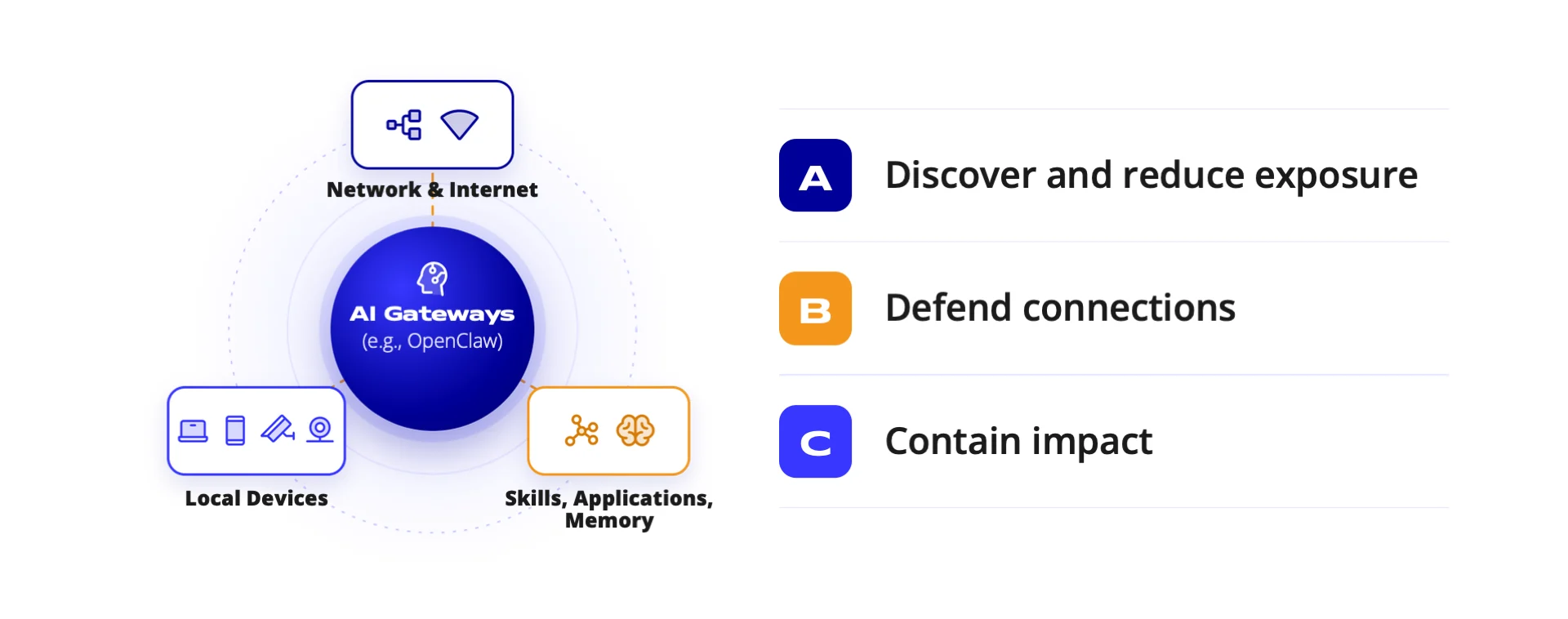
Airties Agentic Shield
The main goal isn’t to defend against AI specifically. It’s to protect against any of the AI and non-AI threats that agentic AI platforms can expose a network to, whether that’s a rogue agent, a malicious website or a malicious skill file. As agentic AI adoption accelerates, this becomes a new, necessary layer in the router-based cybersecurity model Airties provides, protecting not only devices but also the AI systems now operating inside them.
Industry-wide collaboration
Agentic AI risk isn’t a future problem and it’s critical that, as an industry, we come together now to prepare for these emerging risks and protect subscribers. Associations like the Wireless Broadband Alliance (WBA) are a central platform for the ecosystem, and an important enabler of the conversations needed to make progress.
Bruno Tomás, CTO of the WBA, sees the same urgency. “I’ve been describing 2027 as a ‘security reshaping year’ for our industry,” he says. “At the Wireless Broadband Alliance, we have strengthened our security guidelines and made cybersecurity an increasingly proactive priority across our working groups, particularly around secure interworking frameworks, trusted identities and end-user protection. The emergence of autonomous AI agents, alongside post-quantum cryptography and evolving digital trust requirements, takes this challenge to an entirely new level. We are moving beyond securing devices and connections to securing autonomous systems that can make decisions and act on behalf of users.”
“This calls for security by design, trusted identity, continuous monitoring and clear accountability,” Tomás adds. “No single organization can address these challenges alone. Industry collaboration and interoperable security frameworks will be essential to safeguard subscribers, strengthen trust and enable the next generation of intelligent connectivity.”
That is the right perspective. Operators, technology providers and standards bodies each see part of the picture. Protecting subscribers from autonomous threats will take all of them working from shared frameworks, starting now.
To learn more about cybersecurity risks and how to get ahead of the emerging AI-era threats, download the HardenStance analyst report.

Sachin Chickballapur
Chief Technology & Product Officer, Airties
Sachin is the Chief Technology & Product Officer at Airties, leading global product strategy, engineering, customer success, and partnerships to advance the company’s AI-driven connectivity solutions. With over 25 years of experience building high-performance network and cloud products, he previously held senior leadership roles at Juniper, Nokia, Rakuten, NTT Data, and several startups. A key contributor to ETSI NFV and Open Network Foundation SDN standards, Sachin has authored specifications that underpin modern cloud and telecom networks. He holds an engineering degree in Computer Science and Information Technology.

Bruno C. Tomás
Chief Technology Officer, the Wireless Broadband Alliance
Bruno C. Tomás is Chief Technology Officer (CTO) at the Wireless Broadband Alliance (WBA), where he leads global technology strategy and industry collaboration to shape the future of wireless connectivity. His work spans next-generation Wi-Fi, 6G, satellite networks, AI-driven networking, cybersecurity, and seamless interoperability, with a strong focus on the convergence of wireless technologies and global standards. Bruno has played a pivotal role in advancing OpenRoaming and pioneering seamless, secure connectivity deployments across the Americas, Europe, and Asia. Prior to joining WBA, he held engineering and innovation roles at Telecom Operators, driving emerging technology strategies and international standardization initiatives. Bruno holds an BSc in Electrical and Computer Engineering, a MSc in Telecom Networks and is a certified Project Management Professional.
About Airties
Airties empowers operators to provide smooth, smart, secure connectivity. Airties turns smart connectivity into a competitive advantage for operators and enhances how subscribers experience connectivity in the real world: making every connection more intelligent, reliable and secure. Airties’ AI-driven insights enable operators to lower churn, reduce expenses, boost satisfaction, and attract new customers. Across departments, from engineering to marketing, Airties helps increase efficiency, accelerate innovation, and design smarter campaigns. Airties’ holistic suite of hardware-agnostic software enables ISPs to manage connectivity, based on leading industry standards and open-source software, across their fibre, cable/DSL, and fixed wireless access (FWA) deployments. Airties’ customers include leading service providers such as AT&T, Bouygues Telecom, Cox, Deutsche Telekom, Telia, Telstra, T-Mobile US, Vodafone, and many others across the world. More information is available at www.airties.com.
Talk to our team
Want to learn how Airties can help your network? Get in touch and our team will follow up.