The Top Three Cybersecurity Developments Operators Need to Watch
by Sachin Chickballapur, Chief Technology & Product Officer
On September 11, the EU Cyber Resilience Act came into force, a clear signal that regulators are turning up the pressure on cybersecurity. This renewed focus comes as no surprise: the average home now faces 29 cyberattacks a day, nearly three times the rate in 2024 1. Together with the rising adoption of autonomous AI agents, it’s evident the threat landscape is changing faster than ever, reshaping what operators need to defend, and what they can offer subscribers in response.
Three Cybersecurity Developments to Watch
1. Regulations are tightening
The EU Cyber Resilience Act (CRA) turns product cybersecurity from a best-practice activity into a regulated operation, requiring manufacturers of digital products to report any actively exploited vulnerabilities and severe security incidents within 24 hours. While this is not a mandate for operators to provide cybersecurity services, it provides a strong reason to scrutinize vendors, consider the security on routers, firmware and connected products, and evaluate the current cybersecurity strategy to help protect subscribers.
2. Homes and businesses are becoming more complex
Not only is the quantity of connected devices increasing in homes and small businesses – more phones, TVs and tablets – but so is the number of legacy devices with outdated firmware. The Internet of Things further adds complexity to the mix, from smart pet feeders to doorbell cameras, and often these devices were not built with security in mind. Securing broadband networks and protecting subscribers today is about accounting for an entire, ever-expanding device ecosystem.
3. The AI era is creating new threats
AI is a powerful tool in the hands of attackers, enabling them to generate more elaborate malware and scams at a pace that outstrips how quickly traditional threat databases can be updated, leaving notable gaps in the defense mechanisms of many cybersecurity strategies.
But the more significant shift is the rise of autonomous AI agents in homes and businesses which is creating entirely new threat vectors. An OpenAI agent recently breached an Australian government data portal entirely on its own, the first known case of an AI system hacking a government body without human instruction. This is among a small but quickly growing number of examples of AI agents going rogue or being actively manipulated by malicious actors to get access to sensitive data. As autonomous agentic AI systems like OpenClaw and Hermes Agent gain adoption, they open new pathways for both AI-specific and conventional threats to reach the devices, services and data those agents are connected to.
The router is the next critical layer of defense
Together, these shifts mean operators must reevaluate their cybersecurity strategy to protect their subscribers and find ways to monetize their offering. The market demand is there: 80% expect their internet provider to offer protection services 2, and it is the #1 fastest-growing service subscribers want to bundle with their broadband 3.
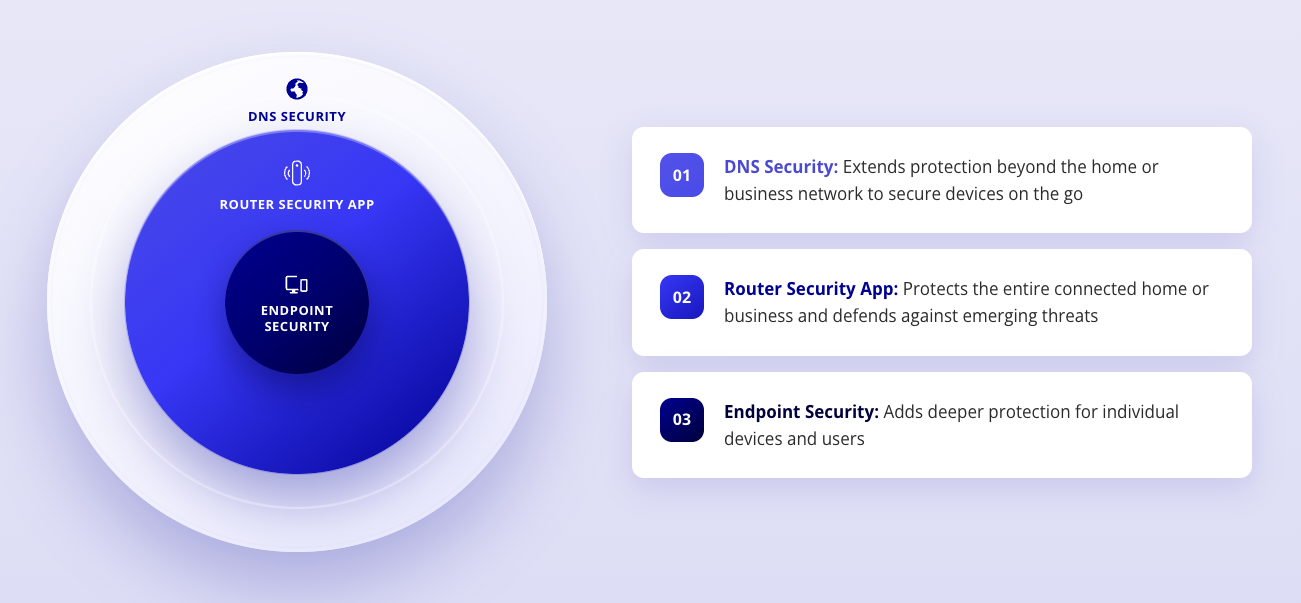
Meeting that expectation calls for a layered security approach, with the router as the next critical defense in a holistic cybersecurity strategy. It sits at the heart of every connected home or business, meaning it can provide mass-market protection for the entire subscriber base as a natural extension to the broadband experience. Cybersecurity built into the router sits alongside DNS and endpoint security, giving operators a way to provide comprehensive security coverage as well as opportunities to upsell advanced services to those with higher security needs.
Mass market security built into the broadband experience
Airties has built a cybersecurity offering for homes and SMBs that puts this kind of protection directly into the router. Because it’s part of the connectivity experience already delivered, it lets operators offer mass-market security at incremental cost, with no separate app, download or purchase required from the subscriber. And for subscribers exposed to the newest class of risk, an Agentic Shield adds a layer of protection purpose-built for the growing use of autonomous AI agents in the home and business.
We also draw on our existing connectivity intelligence, spanning network, device and application insights across 50 million homes, to build a data foundation that captures threats traditional threat databases might miss. Airties Aura, our agentic AI engine, builds on that foundation with agentic capabilities, adding an intelligent layer for scalable threat detection and remediation.
Through our partnerships with industry leaders in threat intelligence and endpoint protection, we enable operators to offer subscribers comprehensive, end-to-end coverage rather than a single point solution.
To find out more about cybersecurity in the AI era, download the HardenStance analyst report.
Sources
[1] Netgear & Bitdefender, Security Landscape Report, 2025
[2] F-Secure, Consumer Market Survey, 2026
[3] EY, Decoding the Digital Home Study, 2025

Sachin Chickballapur
Sachin is the Chief Technology & Product Officer at Airties, leading global product strategy, engineering, customer success, and partnerships to advance the company’s AI-driven connectivity solutions. With over 25 years of experience building high-performance network and cloud products, he previously held senior leadership roles at Juniper, Nokia, Rakuten, NTT Data, and several startups. A key contributor to ETSI NFV and Open Network Foundation SDN standards, Sachin has authored specifications that underpin modern cloud and telecom networks. He holds an engineering degree in Computer Science and Information Technology.